
Can we build Trust? Exploring Personal vs. Professional Trust
- Maria Biquet

- Jul 16, 2025
- 6 min read

Recently I had a meeting with a company client with my business partner about a project we had delivered. We discussed several topics and at some point she told me “you have gained absolute trust from every single person in all six teams. My business partner felt proud and started praising me; I felt grateful and surprised at the same time.“ I have been lucky enough to hear this comment from my clients and ex-managers several times in my life and it seems that this is my advantage as a person. Scottish author and clergyman, George Mac Donald, wrote: “To be trusted is a greater compliment than being loved” and maybe it is. A question started pondering “what do I do that makes people trust me?”. In fact I never try to make people trust me; I am myself in everything I do and I never think of how I should gain people’s trust.
Defining Trust
The question “how to build trust” in Google returned 660.000.000 results; “what is trust” returned 1.970.000.000 results. It seems that Trust is a major concern for people who try to define it and find ways to build it in all kinds of relationships.
Trust is a building bock of a relationship either personal or professional and it is the basis of all forms of organization: families, cities, communities, states, corporations, unions, teams. When the first anthropoids started creating communities they started building trust. Working together and hunting together requires trust. Any activity that is carried out by people “together” is based on trust. “Togetherness” either as a community or city or team requires some form of trust as its basic essence.
The definition of Merriam-Webster is the following: trust (noun)
1a: assured reliance on the character, ability, strength, or truth of someone or something - b: one in which confidence is placed
2a: dependence on something future or contingent : hope - b: reliance on future payment for property (such as merchandise) delivered : credit bought furniture on trust
3a: a property interest held by one person for the benefit of another - b: a combination of firms or corporations formed by a legal agreement especially : one that reduces or threatens
to reduce competition
4a: care, custody the child committed to her trust - b(1): a charge or duty imposed in faith or confidence or as a condition of some relationship - (2): something committed or entrusted to one to be used or cared for in the interest of another - c : responsible charge or office
5 archaic : trustworthiness; in trust : in the care or possession of a trustee
As defined above trust is “assured reliance on the character, ability, strength, or truth of someone or something” and therefore we can distinguish between “assured reliance on character” and “assured reliance on ability”. The two definitions indicate completely different types of Trust.
May we call it Personal Trust vs. Professional Trust
In the first definition Trust is about the personality and the second is about the ability, which is more technical and measurable. Developing abilities and competences, adopting specific behaviours and demonstrating skills will lead to build professional trust. Building professionalism will lead to building trust. All the elements that constitute professionalism lead to create trust in the person’s environment. Clients, co-workers and managers can recognize a person who can deliver at work and trust them for that. Professional trust is very important and vital to build a business and achieve results and therefore people who are serious professionals enjoy trust in their abilities and skills.
On the other hand, Trust as an emotional and deeper dimension in any relationship goes beyond technical abilities and competences; it emanates from the true essence of a person; it is inspired by the personality and the character of a person. It is the quality of “energy” that a person creates around them and makes others feel at ease in his/her presence. It is what makes people share their thoughts and feelings, confide their fears, relax and laugh from their heart. Building the quality of creating Personal Trust is a highly complex project if possible. It would require genuine honesty, fairness and integrity coupled with real care for others.
Can we build Personal Trust?
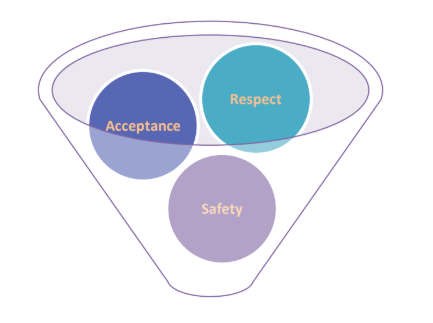
In order to trust personally (and emit oxytocin!) people need to feel
Accepted - Respected - Safe
If we want people to feel the precious Personal Trust in us, in some way we have to reconstruct their family environment in its ideal form; it is the place where the child is accepted without conditions, respected as a precious member of the pack and safe because mommy and daddy always protect and will never hurt him/her.
Can we create those conditions in our environment?
Can we make people feel accepted, respected and safe in our presence? And if we do, will this condition be honest and sustainable or it will collapse in our first disagreement with them?
Respect is a prerequisite for Acceptance. When we truly respect people as human beings we open the way to accept them for who they are. Acceptance is difficult though; we are all raised in a specific set of stereotypes and hierarchy. Success is usually defined by social class, wealth and professional achievement; successful people are highly respected and always accepted even if their behavior is inappropriate and disrespectful to their colleagues or neighbours.
Respect in most cases is reserved for the “successful” while the other categories will usually be treated casually. For example, the CEO of an organisation is always respected by everybody while the cleaner may be treated as a “second class” citizen whose opinion is not to be taken seriously. Respect is not just about talking to a person or typically asking for their opinion, it is about considering their views equally in a decision and involving them in the process.
As a result of Respect comes Acceptance. When we respect people we accept them as they are without comparing them with others, without asking them to do or be something different; we just accept them for who they are, for what they know, for what they do and for what they can or can’t do; we accept them as human beings with their right in participating equally in the process. True Acceptance is when we don’t have expectations from a person; we don’t expect them to behave in a certain way or achieve a goal; we acknowledge the value of their Being as such.
Creating a Safe context resembles the family environment where the child can be themselves without being judged, are protected from danger and rescued if needed. Providing Safety is about being kind and honest. In this context we don’t compete, we support; we don’t criticize, we share ideas and knowledge; we don’t have secret goals, we are open and transparent.
Inspiring Trust starts and ends inside ourselves
Creating an environment of Respect, Acceptance and Safety for others requires breaking social stereotypes that shape our beliefs and unconscious behaviours that automatically lead us to competition, rejection and individual goals.
Competition is hidden behind excellence; rejection is the side effect of preference and individual goals may be called purpose.
Excellence, preference and purpose may be necessary for success in our competitive and unpredictable times but produce behaviours and attitudes that don’t help create the context for Personal Trust.
Before we start trying to build the context for Personal Trust, we should invest time in discovering our beliefs and stereotypes, our attitude and behavior towards others and our expectations about it. If it doesn’t happen easily, we must check our deep rooted beliefs and stereotypes about ourselves and others. It will be a very useful exercise for our own development.
(Further reading: https://en.m.wikipedia.org/wiki/Trust_(social_science)
About Maria Biquet:
Maria Biquet is an experienced multilingual Business Consultant and
Executive Coach with vast experience from diverse business fields, such as Banking & Financing, Automotive, Telecommunications and Education.
Maria has long experience in Strategic Marketing and in establishing companies in new markets. For more than 20 years she has studied various methodologies for self development and change including Neuroscience in Coaching, Systemic approach, Appreciative Inquiry Approach, NLP and mindfulness techniques.
She holds a University degree in Language & Linguistics, an MBA-International Marketing and is a Neurocoach certified by the NBG – Harvard School and a Master Coach certified by the CAC.
Vice President of Marketing & Communications of HCA (Hellenic Coaching Association) EMCC Greece, member of the EMCC (European Mentoring & Coaching Council). Works as a volunteer with Non Profit Organisations: Mentor at Orange Grove for startup companies and at Cherie Blair Foundation.
EMCC Accredited Senior Practitioner
Senior Researcher on Ethics: “the actual Ethical Dilemmas in Coaching today” in collaboration with EMCC.
Works in Greek, English and French.
Email: mariabiquet@gmail.com, Tel.: +30 6944 889526 | www.quantaconsulting.co.za


Comments